
Why the Way You Connect as an Adult Often Begins in Childhood
Our early experiences with caregivers shape how we view ourselves, others, and intimacy. These early emotional bonds, known as “attachments”, form the blueprint for how we connect, communicate, and handle closeness in adult relationships.
Understanding your attachment style can shed light on recurring patterns in your relationships, from why you may crave reassurance to why you might pull away when things get emotionally intense.
What Is Attachment Theory?
Attachment theory, first developed by psychologist John Bowlby and later expanded by Mary Ainsworth, describes how our early experiences with safety, responsiveness, and emotional availability influence how we relate to others throughout life.
When caregivers respond consistently and warmly, children learn that relationships are safe. When care is inconsistent, unavailable, or intrusive, children may adapt by becoming anxious, avoidant, or disorganized in their attachment behaviors.
These learned patterns often continue into adulthood, shaping romantic and emotional relationships in subtle (and sometimes not-so-subtle) ways.
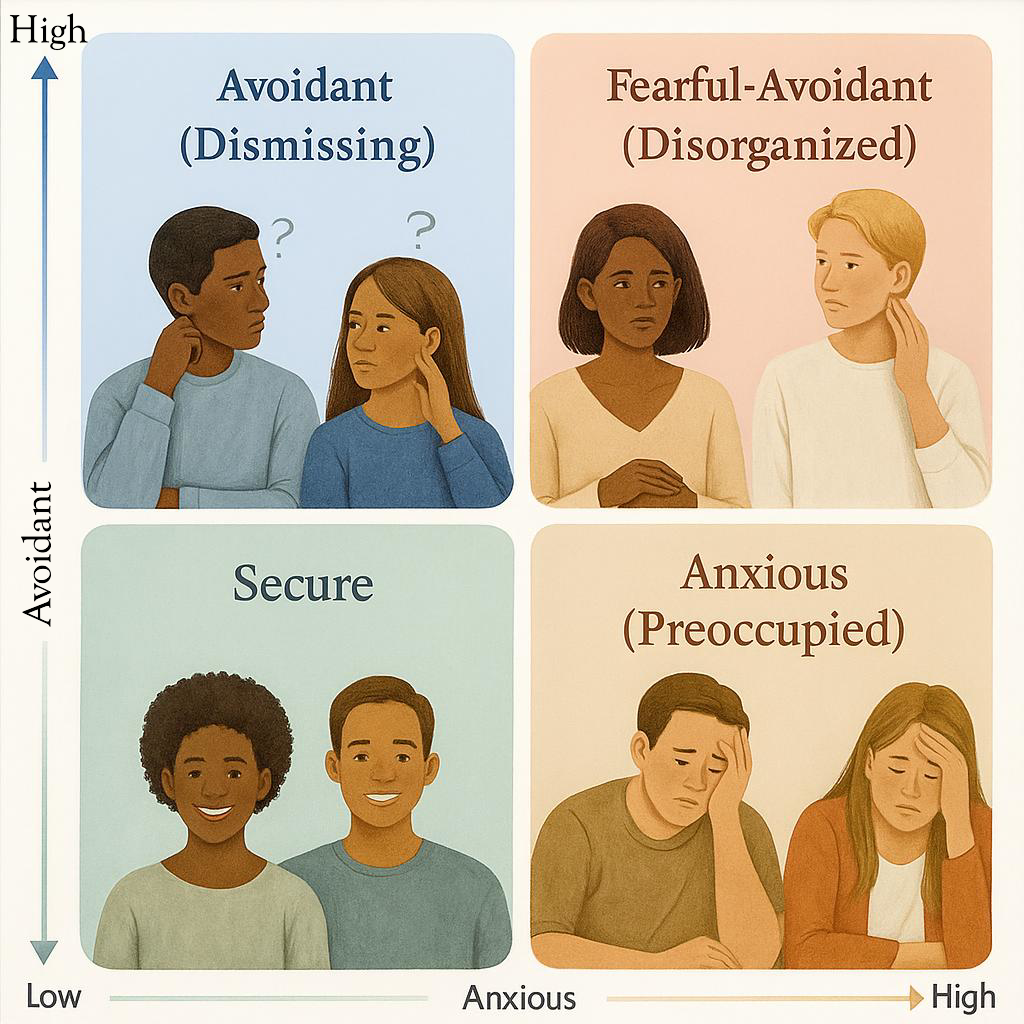
The Four Main Attachment Styles
1. Secure Attachment
Securely attached individuals generally grew up with caregivers who were responsive, consistent, and emotionally available. As adults, they tend to feel comfortable with closeness and independence.
In relationships, secure attachment looks like:
-
Open communication and emotional honesty
-
Confidence that conflict can be resolved
-
Comfort with both giving and receiving love
-
Trust in the partner’s intentions and availability
Core belief: “I am worthy of love, and others can be trusted.”
2. Anxious (Preoccupied) Attachment
Anxious attachment often develops when caregiving was inconsistent—sometimes nurturing, other times distant or unpredictable.
In relationships, anxious attachment may show up as:
-
Worrying about a partner’s love or commitment
-
Needing frequent reassurance or contact
-
Overanalyzing small changes in tone or behavior
-
Fear of being abandoned or replaced
These individuals may become hyper-attuned to a partner’s mood or attention, seeking closeness to feel safe.
Core belief: “I need to work hard to be loved.”
3. Avoidant (Dismissive) Attachment
Avoidant attachment often forms when caregivers were emotionally unavailable, dismissive, or encouraged independence without emotional support.
In relationships, avoidant attachment can appear as:
-
Discomfort with vulnerability or emotional expression
-
A tendency to withdraw when things get too intimate
-
Valuing independence over interdependence
-
Suppressing emotions rather than sharing them
Avoidantly attached individuals may look self-sufficient but often struggle to rely on or fully open up to their partners.
Core belief: “I can only depend on myself.”
4. Disorganized (Fearful-Avoidant) Attachment
This style often develops in childhoods marked by fear, trauma, or inconsistent caregiving—where the caregiver is both a source of comfort and distress.
In relationships, disorganized attachment may look like:
-
Wanting closeness but fearing rejection or betrayal
-
Intense push-pull dynamics (“come close, now go away”)
-
Difficulty regulating emotions
-
A mix of anxious and avoidant behaviors
These individuals often long for connection but also fear being hurt again.
Core belief: “I want love, but I’m afraid it will destroy me.”
How Childhood Connects to Adult Relationships
Our early attachment experiences create internal “maps” for how love and safety work. When those early experiences were inconsistent, our nervous system may interpret closeness as both comforting and threatening.
The good news: attachment styles can be changed.
With awareness, reflection, and supportive relationships (including therapy), adults can develop greater emotional security over time.
Therapy helps individuals recognize old patterns, understand triggers, and build new ways of relating – both to themselves and to their partners. Through consistent, attuned connection, it’s possible to move toward a more secure attachment style.
Healing Through Awareness and Support
Recognizing your attachment style isn’t about blame, it’s about compassion and growth. Whether you tend to withdraw, cling, or oscillate between both, understanding your attachment needs can help you create healthier, more fulfilling relationships.
At Green Jey Psychotherapy, I work with individuals and couples to explore how past attachment wounds may be influencing their present relationships. Using evidence-based approaches such as the Gottman Method and Emotionally Focused Therapy, I help clients build emotional safety, deepen trust, and strengthen connection.
📍 Green Jey Psychotherapy – Scarborough, Ontario